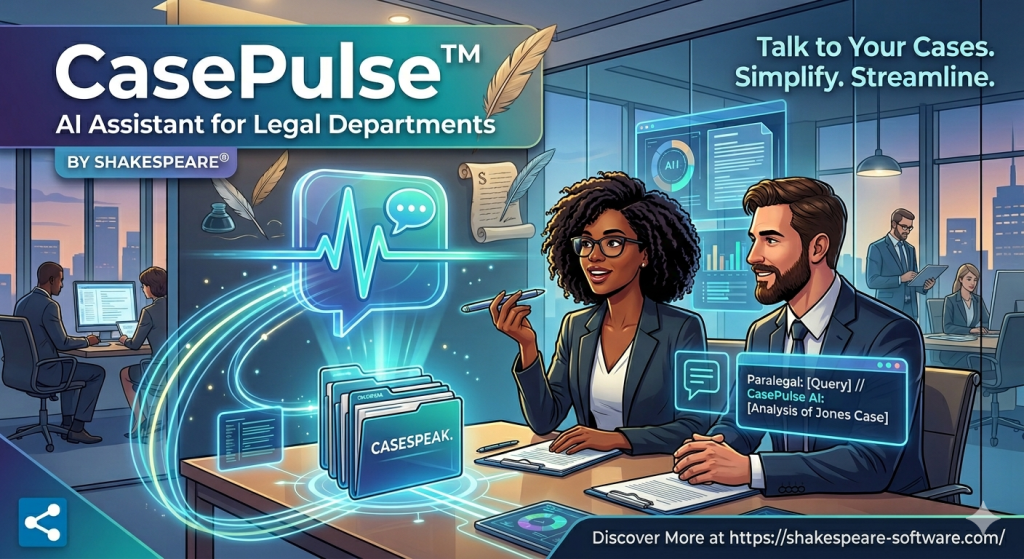
Paralegal instantly access the knowledge inside thousands case documents
With ShakeSpeare®’s new CasePulse™ capability, legal professionals can now interact with their case files using a secure, locally deployed AI assistant.
Unlike public AI services, the AI only has access to documents belonging to the specific case. It cannot search the internet, cannot access other matters, ensuring responses are grounded solely in the available evidence and documentation.
Imagine asking:
✔️ “What are the key obligations and risks in this matter?”
✔️ “What collateral and guarantees secure this exposure?”
✔️ “Summarize all communications regarding repayment arrangements?”
✔️ “Summarize all correspondence regarding contract termination.”
✔️ “What deadlines are approaching in this matter?”
The result is faster case preparation, reduced document review time, and improved consistency across legal teams.
For litigation, restructuring, workouts, compliance investigations, and corporate legal departments, this means less time searching and more time practicing law.
🔒 Local AI.
📁 Case-bound knowledge.
⚖️ Answers based on documents, not assumptions.
Welcome to the future of legal work with ShakeSpeare®.
1.1 Web BLOG:
- CasePulse™: How Local AI is Transforming Legal Work Without Compromising Trust
- The Hidden Challenge in Modern Legal Practice
Every legal matter generates information.
Contracts, correspondence, pleadings, court submissions, witness statements, expert opinions, regulatory filings, internal memoranda, emails, and supporting evidence quickly accumulate into hundreds—or even thousands—of documents.
For lawyers, legal counsels, litigation teams, restructuring specialists, and workout departments, the challenge is rarely the lack of information.
The challenge is finding the right information at the right moment.
A senior attorney preparing for a hearing may spend hours locating a specific statement buried deep inside a document repository. An in-house legal counsel may need to quickly understand years of contractual correspondence before advising management. A restructuring specialist may need immediate insight into financial obligations, guarantees, or creditor communications spread across multiple files.
Legal professionals are highly trained experts. Yet a significant portion of their time is still consumed by searching for information rather than applying legal judgment.
This is precisely the challenge ShakeSpeare®’s new capability CasePulse™ was designed to solve.
- What Is CasePulse™?
CasePulse™ allows legal professionals to communicate with their case files using a secure AI assistant integrated directly into ShakeSpeare®.
Instead of manually searching through folders, documents, emails, and evidence, users can simply ask questions in natural language.
For example:
- What are the claimant’s primary allegations?
- Summarize all correspondence related to settlement discussions.
- Which documents reference the disputed invoice?
- What contractual obligations are relevant to this dispute?
- Identify all references to payment delays.
- What are the key dates and deadlines in this matter?
Within seconds, the system analyzes the documents belonging to the specific case and provides a structured answer.
The result is a dramatically faster path from information to legal insight.
- Built Specifically for Legal Departments
Most AI discussions focus on general-purpose tools trained on vast internet datasets.
Legal departments have different priorities.
They require:
- Confidentiality
- Auditability
- Accuracy
- Data sovereignty
- Controlled access
- Professional responsibility
That is why ShakeSpeare® takes a fundamentally different approach.
The AI is not connected to the public internet.
The AI does not access unrelated matters.
The AI only works with documents explicitly assigned to the specific case.
This creates a secure environment where legal professionals can benefit from advanced AI capabilities without exposing sensitive client information.
- Zero Temperature: Answers Based on Documents, Not Imagination
One of the biggest concerns surrounding AI in legal practice is hallucination—the generation of information that appears convincing but is unsupported by evidence.
In legal work, this is unacceptable.
Court submissions, legal opinions, settlement negotiations, and management decisions require factual accuracy.
For this reason, ShakeSpeare® operates the legal AI environment with a temperature setting of zero.
In practical terms, this means the model is configured to prioritize consistency and factual grounding over creativity.
The objective is not to generate imaginative responses.
The objective is to help legal professionals locate, understand, and summarize information that already exists within the case file.
The AI becomes a powerful research assistant—not a substitute for legal judgment.
- A Powerful Tool for Litigation Teams
Litigation matters often involve enormous volumes of information.
Case teams regularly face situations where they must:
- Review years of correspondence
- Analyze large collections of evidence
- Prepare witness examinations
- Identify contradictions in statements
- Summarize procedural history
- Prepare for hearings under tight deadlines
CasePulse™ allows litigators to interact with the complete documentary record in seconds.
Instead of manually reviewing hundreds of documents, lawyers can ask focused questions and immediately receive relevant summaries and references.
This reduces preparation time while improving visibility across the entire case.
- Supporting Workout and Restructuring Departments
Workout and restructuring professionals face a unique challenge.
Critical information is often dispersed across:
- Loan documentation
- Security agreements
- Guarantees
- Financial statements
- Creditor communications
- Internal assessments
- Regulatory correspondence
When time-sensitive decisions are required, locating key information quickly can significantly influence outcomes.
With CasePulse™ restructuring teams can instantly identify obligations, contractual provisions, key stakeholders, and historical communications.
The result is faster analysis and better-informed decisions.
- Empowering Corporate Legal Departments
In-house legal teams are increasingly expected to do more with fewer resources.
Business units demand rapid answers.
Management requires timely risk assessments.
Regulatory obligations continue to expand.
Yet legal departments are often managing thousands of contracts, disputes, compliance files, and advisory matters simultaneously.
CasePulse™ acts as an intelligent knowledge layer across each matter.
Legal professionals can rapidly obtain context, understand document history, and locate relevant information without interrupting colleagues or conducting lengthy manual searches.
This helps legal teams respond faster while maintaining the quality and rigor expected from legal professionals.
- Security First
For legal organizations, security is not a feature.
It is a requirement.
The architecture behind ShakeSpeareֹ®’s AI capabilities follows the same principles that govern the broader ShakeSpeare® platform: controlled access, enterprise-grade security, permissions, auditing, and support for on-premise deployments. ShakeSpeare® has long been designed for document management, business process management, access control, and secure enterprise environments across legal and other regulated industries.
The introduction of AI does not change these principles.
Instead, it extends them.
The goal is simple:
Keep sensitive legal information where it belongs while making it dramatically easier to use.
- AI That Enhances Legal Expertise
Artificial intelligence will not replace lawyers.
However, lawyers equipped with secure and properly governed AI tools will outperform those who rely exclusively on traditional document review methods.
The future of legal work is not about replacing expertise.
It is about removing unnecessary friction between legal professionals and the information they need.
By enabling users to securely CasePulse™ ShakeSpeare® helps legal departments spend less time searching and more time analyzing, advising, negotiating, and winning cases.
Because legal value is created through judgment—not through document hunting.
And that is exactly where lawyers should focus their time.